
The Most Disappointing NBA Players So Far This Season


The 2026–2027 NBA season is officially underway, and while several players have wasted no time exceeding expectations, others have been making headlines for all the wrong reasons. Whether it's a significant decline in production, inefficient shooting, or simply failing to live up to the hype, some of the league's most recognizable names have gotten off to surprisingly disappointing starts. We're only a couple of weeks into the season, and there's still plenty of time for these players to turn things around, but a lot of this has been difficult to ignore. With that said, let's take a look at the players who have shocked us for all the wrong reasons thus far.
Mikal Bridges (NY)

2026-27 Stats: 6.3 PPG · 2.9 RPG · 2.0 APG · 33.3% FG
Mikal Bridges has been the NBA's ultimate Iron Man, incapable of missing a game regardless of the circumstances. But could all those years of relentless basketball finally be catching up to him? Bridges has gotten off to an absolutely disastrous start, averaging a career-low six points per game on an abysmal 33% shooting from the field. Even more concerning, head coach Mike Brown has shown little hesitation in pulling Bridges from the rotation, most notably benching him for the entire second half of a victory over the Brooklyn Nets and limiting him to just 13–20 minutes in other recent contests.
It's a stunning fall from grace for a player who just won the ultimate prize. Whether it's accumulated wear and tear, a complete loss of confidence, or simply an extended shooting slump, something clearly isn't clicking for Bridges. And for a player who's built his reputation on being consistent and reliable, his sudden disappearance from New York's offense is undoubtedly one of the biggest head-scratchers.
Scoot Henderson (POR)

2026-27 Stats: 8.7 PPG · 2.3 RPG · 1.4 APG · 32.8% FG
At this point, it's fair to wonder whether Scoot Henderson is progressing backward rather than forward. Once considered one of the most electrifying guard prospects in basketball, the former No. 3 overall pick has struggled mightily to establish himself as a dependable NBA contributor. With Ja Morant sidelined, Henderson had a golden opportunity to step up and be the marquee bench point. Instead, the 22-year-old has looked completely out of sorts, averaging a disappointing 8.7 points and 1.4 assists on an atrocious 32.8% shooting from the field and 20% from beyond the arc.
His questionable shot selection, lack of playmaking, and inability to consistently create opportunities for his teammates have been particularly concerning. Even the explosive athleticism when cutting to the basket hasn't looked the same. Now in his fourth NBA season, Henderson should be showing signs of significant improvement, not struggling to find his footing. There's still time for him to turn things around, but if he hopes to become the dynamic floor general Portland wanted on draft night, something has to change fast.
Malik Monk (SAC)

2026-27 Stats: 8.0 PPG · 1.3 RPG · 3.4 APG · 35.1% FG
Malik Monk has been spark-plug shooter in the league for about a decade now, capable of checking into a game and providing an instant offensive jolt off the bench. However, there's a fine line between being an aggressive scorer and just forcing up shots whenever the opportunity presents itself. Unfortunately, Monk has found himself on the wrong side of that line far too often to begin the season. After averaging 12.5 points on 43.8% shooting last season, Monk has stumbled out of the gates, producing just 7.2 points per game on an ugly 36.6% from the field. His questionable shot selection and inability to consistently establish an offensive rhythm has been frustrating for a Kings team that currently sits at 1-7. Granted, Monk's minutes have decreased considerably, but there's a difference between playing with confidence and playing recklessly. If Monk hopes to reclaim his reputation, he'll need to rediscover his efficiency.
Jalen Green (PHX)

2026-27 Stats: 12.8 PPG · 3.3 RPG · 3.3 APG · 40.3% FG
Remember when NBA fans were having heated debates over who would become the better player between Jalen Green and Cade Cunningham? Yeah, those days feel like a distant memory. While Cunningham has blossomed into an All-NBA First Team talent, Green's once-promising trajectory has taken a troubling turn. After arriving in Phoenix with expectations of becoming a franchise scorer, the former No. 2 overall pick has struggled in every which way. Injuries limited Green to just 32 appearances last season, but even with a fresh opportunity as the Suns' starting shooting guard, Green has been anything but reliable.
Averaging just 12.8 points per game on 40.3% shooting from the field and a miserable 23.1% from beyond the arc, Green has looked more like an offensive liability than the explosive three-level scorer we once knew. His athleticism and scoring potential have never really been in question, but his inconsistency and inefficient shot selection continues to hold him back. Now entering his sixth NBA season, it's becoming increasingly difficult to excuse these struggles as growing pains. At some point, potential has to translate into production.
Josh Giddey (CHI)
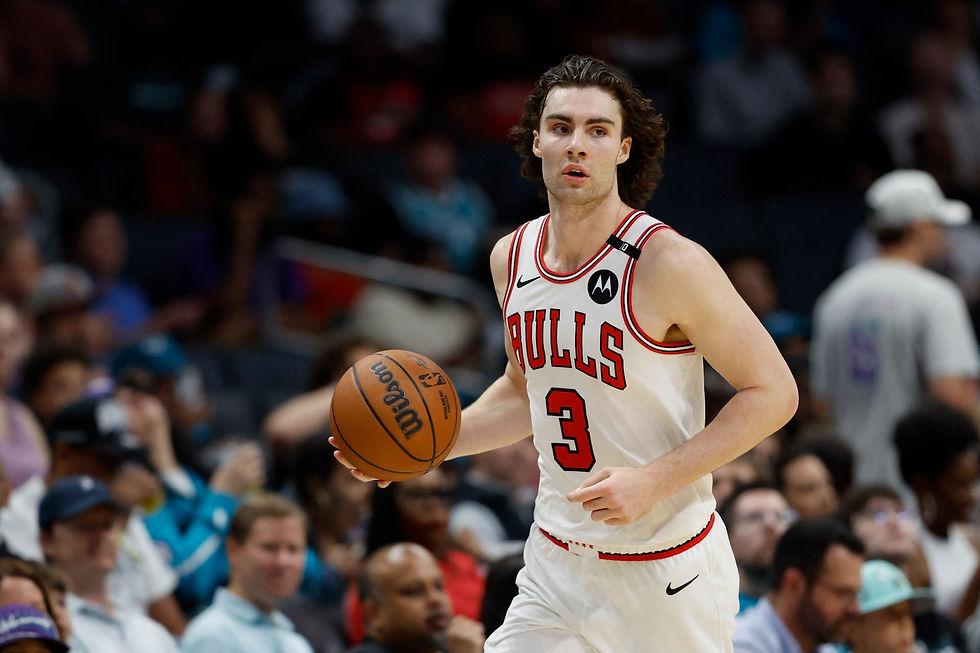
2026-27 Stats: 9.3 PPG · 4.6 RPG · 7.6 APG · 38.9% FG
Josh Giddey's court vision and passing ability remain among the best in the business, but has he completely forgotten how to put the ball in the basket? Coming off a career year in which he averaged 17.0 points, 8.3 rebounds, and 9.1 assists, Giddey was expected to take another significant leap as the leader of Chicago's offense. Instead, Josh has gotten off to an alarmingly sluggish start, averaging just 9.3 points on a dismal 38.9% shooting from the field and 28.6% from beyond the arc. While his 7.6 assists per game demonstrate that his playmaking is still elite, his lack of offensive aggression and inability to consistently knock down shots have made life considerably easier for the defense.
To be fair, Giddey underwent arthroscopic surgery on his right ankle in May and dealt with a sprained left wrist shortly before the season began, two setbacks that could be contributing to his shooting confidence. But Chicago's disastrous 1–7 start has only magnified his struggles, and the Bulls desperately need their starting point guard to become a scoring threat again. Giddey can still orchestrate an offense with the best of them, but until he starts looking for his own shot and making defenses respect it, Chicago's offensive woes may be here to stay.
Lauri Markkanen (UTA)

2026-27 Stats: 17.1 PPG · 6.6 RPG · 2.1 APG · 38.7% FG
Lauri Markkanen was arguably the biggest All-Star snub from last season, putting up an impressive 26.7 points per game while showcasing his versatility as one of the league's most dangerous three-level scorers. Standing at 7'1", the Finnish forward can stretch the floor, attack the basket, and score over smaller defenders, making him a matchup nightmare on any given night. Unfortunately, that version of Markkanen has been noticeably absent to begin the season. The 29-year-old is averaging just 17.1 points per game on an underwhelming 38.7% shooting from the field, a significant decline from his 47.7% mark last season.
Even more concerning, he's still logging over 30 minutes per contest, making his offensive regression difficult to overlook. Granted, Markkanen has been battling a wrist injury, which could help explain his struggles. Nevertheless, with Jaren Jackson Jr. sidelined due to a torn MCL, Utah desperately needs Markkanen to take command of the offense and assert himself as the team's primary scoring threat. The opportunity is certainly there, but whether Markkanen can rediscover his All-Star form remains to be seen.
Jordan Poole (NOP)

2026-27 Stats: 6.0 PPG · 2.0 RPG · 3.0 APG · 19.0% FG
It's been a rather sad fall from grace for Jordan Poole, whose once-promising career has seemingly taken another turn for the worse. After showing flashes of being a "takeover scorer" during his stint in Washington, including the 2024–25 season in which he averaged 20.5 points per game, Poole has struggled mightily to find his footing in New Orleans. Things have only gotten uglier to begin the 2026–27 season, with the former NBA champion averaging a career-low six points per game on an absolutely horrendous 19% shooting from the field and 21.4% from beyond the arc. Granted, he's averaging just 16 minutes per contest, but even in his limited opportunities, Poole has been virtually invisible offensively.
To make matters worse, head coach Jamahl Mosley appears to be running out of patience, recently handing Poole a DNP-CD against Utah despite the guard being available to play. With Mosley emphasizing defensive toughness and versatility, Poole's questionable fit within the Pelicans' system has become increasingly apparent. At just 27 years old, there's still time for him to salvage his career, but it's becoming increasingly difficult to recognize the electrifying young scorer who once helped Golden State capture an NBA championship.
Ryan Rollins (MIL)

2026-27 Stats: 11.3 PPG · 4.8 RPG · 4.5 APG · 36.1% FG
After finishing fifth in Most Improved Player voting last season, Ryan Rollins appeared destined to become one of the NBA's next breakout guards. Unfortunately, his alarming regression to begin the 2026–27 campaign has raised questions about whether last year's impressive showing was merely a fluke. With Kevin Porter Jr. waived ahead of the season, Rollins had a golden opportunity to be a leader in Milwaukee's backcourt. Instead, the 24-year-old has struggled tremendously, averaging just 11.3 points per game on an abysmal 36.1% shooting from the field and 29.3% from beyond the arc. That's a far cry from the 17.3 points he averaged on 47.2% shooting last season.
To his credit, Rollins has shown a greater willingness to facilitate and involve his teammates, an encouraging development for a combo guard who drew criticism for not having a definitive position. However, his questionable shot selection, inconsistent scoring, and inability to generate efficient offense have done little to rescue the struggling Bucks, who find themselves sitting at a miserable 1–7. While it's far too early to write off his breakout campaign as a one-year wonder, Rollins certainly hasn't looked like the ascending young guard Milwaukee was counting on.
Andrew Wiggins (MIA)

2026-27 Stats: 9.4 PPG · 2.8 RPG · 1.4 APG · 42.9% FG
The Andrew Wiggins we knew is gone. Once a highly touted No. 1 overall pick who blossomed into an All-Star and NBA champion, Wiggins has looked like a shell of the player we once watched dominate stretches of games in Minnesota and Golden State. At just 31 years old, the Canadian forward has taken a considerable step backward, averaging a disappointing 9.4 points and 2.8 rebounds on 42.9% shooting from the field and 31.4% from beyond the arc. While the arrival of Giannis Antetokounmpo in Miami has understandably reduced his offensive responsibilities, Wiggins' "struggles" extend beyond the box score. His offensive aggression has seemingly vanished, his shot selection has become increasingly passive, and the defensive intensity hasn't been on display.
What concerns me is just how uninspired his performances have looked at times, raising questions about whether he can rediscover any sort of hunger that helped him become an integral part of Golden State's 2022 championship run. This certainly isn't the Wiggins we've grown accustomed to seeing, and at an age when he should still have plenty left in the tank, his sudden decline is difficult to explain. Hopefully, this early-season funk doesn't last much longer, because the Heat could certainly use the versatile, aggressive, two-way contributor Wiggins has proven capable of being.
James Harden (CLE)

2026-27 Stats: 16.6 PPG · 5.2 RPG · 6.3 APG · 37.9% FG
James Harden has seemingly embraced his transition into a traditional floor general with open arms, but in today's NBA, just how effective can a point guard be if he struggles to put the ball in the basket himself? The former MVP has been one of the modern era's best playmakers, routinely finishing at the top of the assists leaderboards. However, his scoring efficiency is leaving plenty to be desired. After averaging 23.6 points and 8.0 assists last season, the 37-year-old Harden has seen his production dip to just 16.6 points and 6.3 assists per contest, shooting an underwhelming 37.9% from the field.
While Harden remains a capable facilitator, his questionable shot selection and inability to consistently generate efficient offense have been difficult to overlook. Granted, playing in Cleveland requires him to sacrifice some scoring opportunities, but even in a reduced offensive role, Harden needs to remain a credible scoring threat to keep the Cavs fully competitive. The days of watching The Beard casually drop 40-point triple-doubles may be behind us, but Cleveland still needs more from Harden if they hope to compete with the Eastern Conference's elite.
Bennedict Mathurin (NOP)

2026-27 Stats: 6.5 PPG · 2.4 RPG · 1.6 APG · 40.4% FG
Bennedict Mathurin is finding himself in a situation eerily similar to that of Jordan Poole, struggling to carve out a meaningful role in New Orleans' crowded rotation. Once regarded as a microwave scorer, Mathurin built up a reputation for being able to generate offense seemingly at will, whether attacking the basket, drawing contact, or creating his own shot. Unfortunately, his offensive firepower has been nowhere to be found to begin the season. After averaging an impressive 17.6 points and 5.4 rebounds last season, Mathurin has stumbled to just 6.5 points and 2.4 rebounds per contest on 40.4% shooting from the field and an ugly 22.7% from beyond the arc.
Mathurin's playing time has plummeted to roughly 17 minutes per game, but his inability to consistently make the most of any of his opportunities hasn't helped his case. With head coach Jamahl Mosley emphasizing defense and a more balanced offensive approach, Mathurin has struggled to establish himself as a dependable contributor. Mathurin still has plenty of basketball ahead of him, but he'll need to rediscover his offensive rhythm and prove he can contribute beyond scoring if he hopes to regain a prominent role in New Orleans.
Kelly Oubre Jr. (IND)

2026-27 Stats: 9.4 PPG · 2.6 RPG · 1.6 APG · 42.9% FG
A seasoned NBA journeyman with over a decade of experience under his belt, Kelly Oubre Jr. has been a versatile, high-energy wing capable of providing a scoring punch for whatever team he plays for. Unfortunately, his latest stop in Indiana hasn't exactly gotten off to a smooth start. After averaging a respectable 14.1 points per game last season, Oubre Jr. has struggled to find his offensive rhythm with the Pacers, averaging just 9.4 points and 2.6 rebounds on 42.9% shooting from the field through seven appearances (including five starts).
His outside shooting has been particularly disappointing, connecting on just 25.9% of his three-point attempts. To make matters worse, Oubre has been battling lower-body setbacks, including a troublesome left knee injury. Because of this, his playing time has decreased considerably, but for a veteran who's made a career out of attacking the basket, playing with emphatic energy, and providing instant offense, his lack of production kind of makes it feel like Indiana isn't the best fit. The Pacers could eventually use him in different wats, and hopefully, Oubre will put his injury woes behind him and rediscover his scoring touch before these early struggles become a season-long concern.
Harrison Barnes (SA)

2026-27 Stats: 3.8 PPG · 0.3 RPG · 0.0 APG · 50.0% FG
What happened to Harrison Barnes? A dependable veteran with well over a decade of NBA experience, Barnes has seemingly been pushed completely out of San Antonio's rotation despite being perfectly healthy. After averaging 9.9 points per game last season, the former NBA champion has seen his production plummet to a career-low 3.8 points per contest while logging just 10.8 minutes per night. Granted, the Spurs have developed into a legitimate playoff contender with a dynamic, guard-heavy offense, and the offseason acquisition of Tobias Harris was always going to complicate Barnes' role. But here's the real head-scratcher: Harris has yet to make his season debut due to a lingering calf injury, and Barnes still doesn't play.
Head coach Mitch Johnson has instead leaned heavily on younger contributors like Julian Champagnie and Keldon Johnson, leaving Barnes dog-fighting for whatever minutes he can get. What's particularly frustrating is that Barnes hasn't even been shooting poorly. While San Antonio's youth movement is understandable, it's difficult to imagine such a reliable veteran becoming an afterthought this quickly.
Rudy Gobert (MIN)

2026-27 Stats: 7.5 PPG · 11.9 RPG · 1.5 APG · 42.6% FG
Four-time Defensive Player of the Year Rudy Gobet has never been known for his offensive, but his struggles around the basket have been downright astonishing. While Gobert remains an absolute monster on the glass, averaging nearly 12 rebounds per game, his offensive production has fallen off a cliff. Gobert is averaging just 7.5 points on an abysmal 42.6% shooting from the field, a staggering decline from the 68.2% he converted last season. For a player who has led the NBA in field-goal percentage multiple times, including seasons where he eclipsed the 70% mark, these numbers are almost impossible to believe.
Even more concerning, Gobert has struggled to convert routine layups and close-range opportunities that were once automatic, highlighted by a brutal two-game stretch against Cleveland and Golden State in which he missed all 13 of his field-goal attempts. He's even experimented with the occasional three-pointer, despite making zero in his NBA career. Gobert's rebounding remains elite, but his offensive struggles have occasionally been costly for Minnesota. Finishing efficiently around the basket should be the bare minimum for a player of his size and experience. Hopefully, this bizarre shooting slump is nothing more than an early-season anomaly.
Gary Payton II (GSW)

2026-27 Stats: 4.6 PPG · 2.0 RPG · 0.5 APG · 43.6% FG
Gary Payton II has never been your prototypical NBA point guard. He's not a reliable perimeter shooter, he's not a playmaker, and his offensive limitations have been well documented. But what he lacks in traditional guard skills, he's typically made up for with relentless hustle, suffocating on-ball defense, and an uncanny ability to disrupt opposing offenses. Unfortunately, even those trademark qualities haven't consistently been enough to mask his struggles to begin the saeson. After averaging 7.5 points on an impressive 58.3% shooting last season, the Payton has stumbled to just 4.6 points and 0.5 assists per game, converting a disappointing 43.6% of his field-goal attempts and an abysmal 18.8% from beyond the arc.
For a Golden State team that relies heavily on three-point makes, Payton's inability to provide meaningful scoring or playmaking off the bench has become increasingly concerning. Granted, his defensive energy has shown signs of life here in November, but when you're contributing so little offensively, your impact on the other end has to be exceptional. Payton has built an entire NBA career on defying conventional expectations for a guard, but unless he can rediscover his defensive consistency and become a more dependable offensive contributor, his place in Golden State's rotation could become increasingly difficult to justify.
_ _ _ _ _ _ _ _ _ _ _ _ _
The season is still young, and fortunes can change in the blink of an eye. While these players have gotten off to disappointing starts, there's still plenty of basketball left to be played and more than enough time to silence the critics. Which of these players have disappointed you the most so far this season? Who's been the biggest shocker of them all, and who do you think is destined to turn things around? Let us know your thoughts, and stay tuned for more coverage as the 2026–27 season heats up!
The NBA regular season is in FULL session 🚨 Can't keep up with the hype? Be sure to stay tuned into Sportz Nation for your sports updates on all things basketball.
Thanks for reading!
-Joel Piton
(@jp7ton)


Comments