
The 2026 F1 Season Explained

Updated: Mar 3
by Matt Hylen
Sportz Nation - 2/3/2026

With the 2026 Formula One season right around the corner, the sport is looking extremely different from what it looked like just a year ago. From two new teams to entirely new regulations, F1 has entered a new era of racing.
But how different does it look? What should fans expect before the season? What should fans know? Well, you've come to the right place, as I have gathered all information from various sources to bring you one big guide to the 2026 F1 season. So, let's get right into it!
What Are These New Engine Regulations?
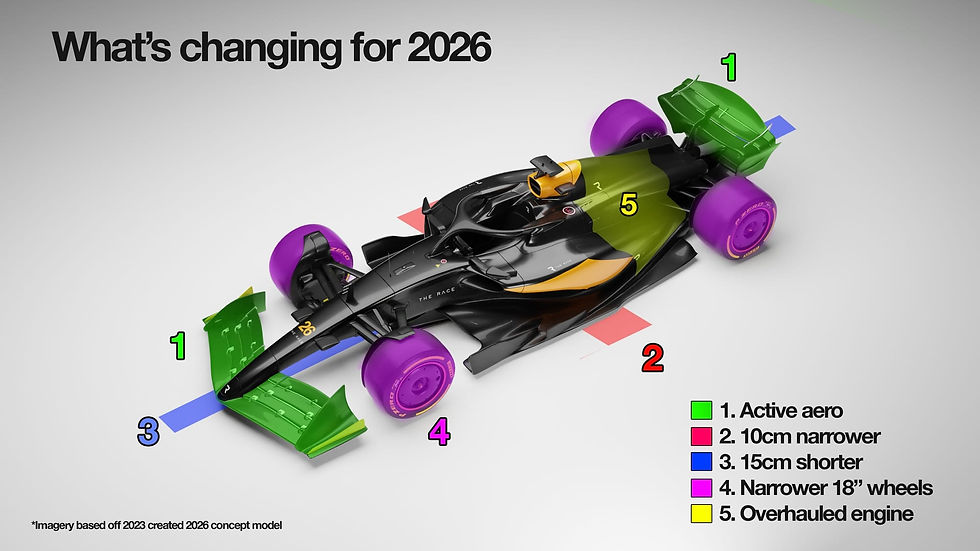
This season, F1 is undergoing one of the biggest regulation changes we have seen in some time. The sport has completely changed the aerodynamics of the car while also overhauling the balance within the engine.
Looking at number 1 on the graphic above, you can see that the car now has what is called "active aero." Basically, instead of the normal DRS-style overtaking method we are used to, F1 has replaced that by giving the car three different modes in order to attempt to overtake or defend an overtake.
For example, the car itself has become smaller, as well as the tires and both the front and rear wings. This should allow cars to pass through air more easily and gain more speed as they go along the track.
Along with the rear wing, the front will also have movable flaps in order to decrease drag on high-speed corners as well as long straights. Depending on the mode the driver puts the car in, both wings will now work together in order to hopefully decrease the difficulty of overtaking and defending.
It is also very important to note the balance between fuel energy and electrical energy that the car will be using this year. Typically, the balance within the engine would be 70% fuel to 30% electrical; however, starting this season, the engine will have an even 50-50 split.
In light of these new regulations, considering who is carrying what engine will be crucial to potential season success since it is so engine-reliant. Mercedes' engine seems to be the front-runner at the moment. Cars carrying this engine include Mercedes, McLaren, Williams, and Alpine. Ferrari's engine also has looked decent durability-wise, which is being carried by Ferrari, Haas, and Cadillac. Ford has partnered with Red Bull to make their own engines, which will be carried by Red Bull and VCARB. Audi will also be making their own engine, with Honda being responsible for the creation of Aston Martin's engine.

There will also be three different modes that drivers can choose from as the race progresses, which will look different from previous years.
The first mode is "Boost Mode." Similar to previous seasons, when the driver hits the "boost" button on their steering wheel, it will trigger a change in the power unit's (AKA the engine) power settings, giving the car its maximum power for however long the driver chooses or until the battery holding the electrical power runs out. With drivers allowed to use this at any point in the race and not just specific parts, the hope is that it will not only help with overtaking but also allow cars the ability to defend themselves if a car behind is trying to overtake them.
The second mode is "overtake" mode. This is the new method that the sport is introducing this season. Basically, it will aid drivers' performance and is designed to deliver more wheel-to-wheel racing. This mode can only be activated when a car is a second behind a car ahead at a detection point on-track. Think of it as a new-and-improved style of DRS, but the extra speed it gives a driver comes from the engine and aerodynamics rather than just the aerodynamics.
The third mode drivers can choose from is called "recharge" mode. To put it simply, drivers will have to strategically use this mode in order to refuel the electrical energy that they may have used at different points in the lap. This mode signals to the engine to harvest the battery rather than deploy it whenever the driver is lifting and coasting.
What is the Grid Looking Like and How Has the Response Been to the New Regulations?

Looking at the grid this season, there haven't been as many changes as we saw last year. Former VCARB driver Isack Hadjar has been promoted to Red Bull to drive alongside Max Verstappen, taking the place of Yuki Tsunoda, who is now without a seat. Rookie 18-year-old prospect Arvid Lindblad takes Hadjar's place at VCARB and will drive alongside Liam Lawson. The rest of the grid is the same as last year, with Cadillac going with Valtteri Bottas and Sergio Perez as their lineup.
Speaking of Cadillac, they will be joining F1 as the sport's 11th team, marking a new era for racing. Alongside them is another new team in Audi, which Sauber's team transitioned into.
In terms of the reaction to the regulations, it has been mixed to say the least. Some drivers, such as Esteban Ocon, Charles Leclerc, and Fernando Alonso, are not so sure these new regs have made overtaking easier. Max Verstappen has even called it “anti-racing” and “formula-e on steroids,” with Lewis Hamilton stating you’ll “need a degree” to understand all the new terms. With that said, some drivers, like Lando Norris and George Russell, spoke of the regulations as a "fun challenge" that they are enjoying.
When considering all the quotes that have been released by drivers thus far, understand that everything is still in an extremely early phase. Though the drivers have gone through two of the three rounds of testing as of the time of this article's release, it is extremely difficult to determine whether or not these regulations will help racing until we actually see competitive sessions. So, don't be alarmed just yet, give it a little more time and allow the drivers time to understand how to best tackle all these new regulations.
What can be Learned From Testing So Far?

So far, the teams have undergone two weeks of testing, one in Barcelona and one in Bahrain. Though we won't get a concrete glimpse of the potential pecking order until the last week of Bahrain testing is complete, there are some assumptions that can be made.
To start, the front-runners still seem to be the same as the previous year, with Mercedes, Ferrari, McLaren, and Red Bull leading the charge. Mercedes has been the favorite all season long but has noted that Red Bull has looked much stronger on straights and even called them the "benchmark." Meanwhile, you have teams like Aston Martin and Red Bull marking Mercedes as the team to beat.
Ultimately, everything you hear during testing from the drivers about who looks the best should be taken with a grain of salt. Teams always downplay their own performance and hype those of other teams in order to potentially hide what they are truly capable of. So, a lot of mixed reviews will happen between now and Melbourne, so do not be fooled or make too many assumptions!
Another team to note that has looked better than expected is Haas. Haas has quietly put together two very nice rounds of testing, making them a very interesting team to watch. If all is what it looks like, we could possibly see Haas as the favorite to come out atop the midfield by season's end. Again, just an assumption, but one worthy of noting.
On the other side of things, two teams have looked particularly concerning as we go through the testing period.
First is Williams. Due to the car being overweight and unready to perform on track, the team was unable to make it to Barcelona and undergo testing there. This is a major setback for the team that could impact the data they get on the car before the season starts. Missing an entire week of testing, especially with the car being brand new, is a huge blow for a team with high aspirations.
The second is Aston Martin, who seem to be in absolute shambles right now. There has been nothing but negative feedback on the car thus far, which is the worst-case scenario for them. Fernando Alonso already seems extremely upset, with Lance Stroll even stating that they are four to five seconds behind Mercedes right now. Chief Technical Officer and F1 legend Adrian Newey also detailed how, due to the wind tunnel repair the team performed, the team started their 2026 prep four months after the window opened.
Again, it is hard to take any of this to heart until we see competitive laps, but with what the team is saying and the lap times they've put together in testing, we could be witness to an absolute disaster within the Aston Martin camp.
What Should Fans Expect Heading into the Season?

Honestly, at this point, expect the unexpected. What we predict now or assume now based on the information we are given could look entirely different in the weeks to come. With the drivers still getting used to these brand new cars and the regulations themselves unproven in terms of racing, it is too soon to say whether or not the rumors going around are true.
With that said, I do think we will have a slight idea of the pecking order very soon. Of course, the consensus is that the Mercedes engine is the most effective, with Mercedes being the team to beat. Yet, Ferrari's engine has been the most reliable so far, with teams giving Red Bull their praise. A lot of contradictory talk is happening, yet that should excite fans. Not knowing who the true favorite is makes this sport so exciting and unpredictable.
So enjoy the chaos, enjoy the unknown, but also expect the unexpected as we head into a new era of Formula One.
Stay tuned for more F1 content, as much more preseason content will be heading your way!
Be sure to check out fansonlysportz.com for more sports media content posted daily.
Also, be sure to check out and follow my socials @matthylen_, where I post all my articles!
Until next time!
-Matt Hylen


Comments